
The Cognitive Science of Clutter: Why Your Brain Craves Minimalism

Clutter is often described as “overwhelming,” but the interesting part is why it feels that way. Most people sense the mental weight of a crowded room or an overflowing desk, yet they rarely connect that feeling to what’s happening inside the brain itself.
Minimalism often gets framed as an aesthetic choice—clean shelves, tidy corners, open space. But beneath all of that, there’s a cognitive story unfolding. A scientific one. And once we understand how the mind handles visual and mental information, it becomes more clear why fewer objects so often leads to a lighter experience of daily life.
If you're someone exploring simplicity, this article offers a peek into the brain mechanics behind clutter. Why too many objects feel like “too much,” and why minimalism isn’t just about style, but about reducing cognitive load in a real, neurological sense.
Why Clutter Feels Heavy: A Look Inside the Cognitive System
At any given moment, your brain is working to make sense of every object in your environment. It identifies shapes, tracks movement, suppresses distractions, and highlights what matters most. But that system, impressive as it is, has limits.
Miller’s Law: The Magic Number Seven
Psychologist George Miller proposed that the human mind can hold around 7 ± 2 pieces of information in working memory at once.
Not 50. Not 30. Not even 15.
Just a small handful.
And while this rule isn’t perfect or universal, it captures something essential: the brain doesn’t manage endless input gracefully. When your environment contains more items than your working memory can comfortably track, your brain shifts into a form of silent overwork—monitoring, comparing, filtering, suppressing.
Even if you’re not consciously thinking about your surroundings, your mind is processing them.
This is where cognitive load enters the picture.
Cognitive Load Theory: The Brain Has Bandwidth Limits
Cognitive load theory explains that the brain has a limited capacity for processing information at any moment. When external demands become too high, performance drops. Focus becomes harder. Stress rises. Tasks feel heavier than they should.
Clutter increases all three forms of cognitive load:
- Intrinsic load — the natural difficulty of the task
- Extraneous load — distractions that interfere with focus
- Germane load — the effort needed to form meaningful understanding
Clutter specifically increases extraneous load, adding mental noise that drains your ability to focus, decide, or shift attention smoothly.
Even if the clutter is familiar, the brain doesn’t stop processing it.
This is why a messy desk can make an easy task feel difficult. Or why a crowded room feels louder—even in silence.
How Many Objects Can You Actually Track? More Science, Less Guesswork
Several cognitive studies offer clues:
1. Visual Attention Has a Sharp Limit
Research on top-down and bottom-up mechanisms shows that the brain can only spotlight a few objects at a time. The rest must be actively suppressed. The more objects present, the more the brain must work to filter noise from relevance.
2. Distracter Suppression Isn’t Free
The paper Neural evidence for distracter suppression during visual search tells us that each unnecessary object competes for attention, even if you’re “ignoring it.” The brain constantly suppresses irrelevant objects. But suppression has a cost—it drains mental resources.
3. Subitizing vs. Counting
Humans can instantly recognize up to four objects without counting—this is called subitizing. Beyond that, attention slows, and the brain must work harder.
This means a cluttered shelf with 20 items isn’t neutral—it’s 20 individual signals requiring attention, suppression, or interpretation.
Even “organized clutter” still demands processing.
Why Minimalism Reduces Cognitive Strain
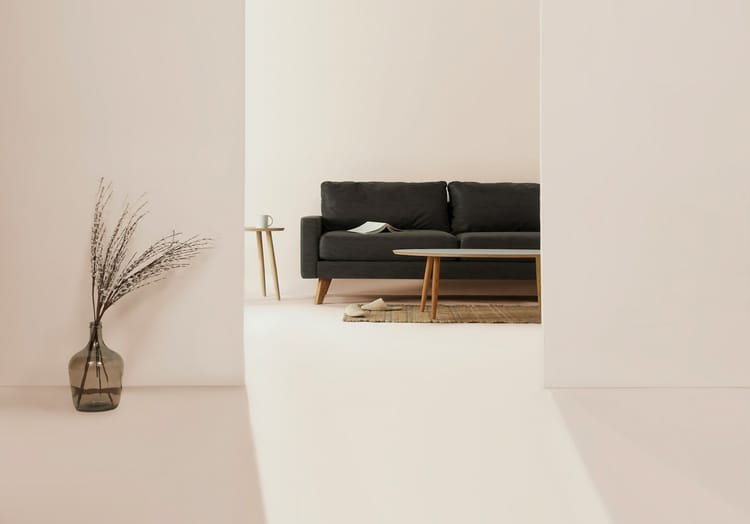
Minimalism isn’t about creating empty spaces. It’s about creating clear ones—rooms that don’t require constant mental filtering.
When your environment contains fewer objects:
- The brain can relax sooner
- Focus improves without effort
- Decision fatigue decreases
- Stress hormones lower
- Working memory becomes available for actual tasks
A minimalist space doesn’t just look calm.It makes you feel calm because your brain is finally getting a break.
This is why so many people describe minimalism as “breathing room.”
It’s not poetic—it’s neurological.
Where Physical Clutter Becomes Mental Clutter
The transition is subtle:
A cluttered drawer → visual noise
Visual noise → cognitive noise
Cognitive noise → mental fatigue
Mental fatigue → overwhelm
Minimalism interrupts that chain early, before overwhelm becomes the default.
Even small changes—clearing a nightstand, simplifying a workspace, reducing surface-level items—offer outsized benefits because the mind notices every reduction in input.
It’s not about owning little; it’s about owning in a way that supports clarity.
A Soft Step Toward What Comes Next
If clutter has ever made you feel tired, scattered, or strangely irritable, it isn’t a personal flaw. It’s simply your brain doing its best with more information than it’s wired to handle smoothly.
Minimalism steps in as a kind of kindness—lightening cognitive load, offering clarity where there was noise, and giving the mind the space it quietly needed all along.
And the beautiful thing is: You don’t need to change everything at once. Even removing a few items can change how your mind feels in a room.
Minimalism doesn’t start with emptiness. It starts with ease.

Comments ()