
The Endowment Effect: Why We Overvalue What We Own and How Minimalism Helps
Minimalists often talk about the art of letting go, but parting with possessions isn't always easy. Each item, a worn sweater, a forgotten kitchen gadget, or a pile of unread books, carries a story or memory, making you pause and ask yourself: Why am I holding on?
The solution is not feeling or indolence. This is what behavioral economics has been researching for decades, and it has been a secret.
We refer to this as the endowment effect, and once we are aware of it, decluttering will be a more purposeful and less emotional process. We are no longer struggling with the uncomfortable state, but we are starting to perceive it with interest and empathy.
What is the Endowment Effect?
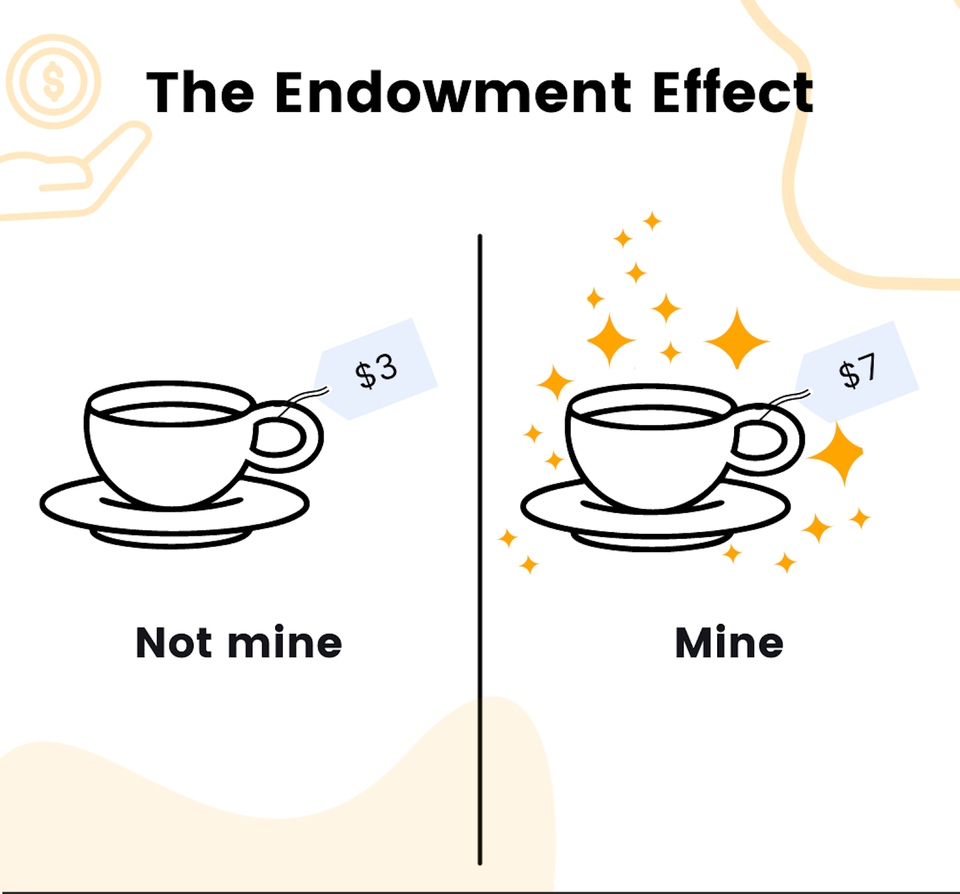
Daniel Kahneman, Jack Knetsch, and Richard Thaler showed in their groundbreaking work that ownership in itself overvalues what we hold. When respondents were given a mug, they demanded a considerably higher price to sell it than non-owners, who were willing to pay for it. There was nothing different about the mug—just the feeling of ownership.
To minimalists, this is the reason why particular objects are sticky. We avoid losing something not because it is special, but because it is highly valued compared to the loss itself. Our value is confounded with our ownership.
Loss Aversion: The Hidden Force behind Clutter
Loss aversion—a key psychological principle—helps explain why letting go of things can feel so difficult. Humanity is inherently risk-averse to losses. It hurts almost twice as much to lose something as it feels good to gain something similar.
This implies that we may have complete knowledge of the logic of letting something go but still experience resistance. Even a shirt we will never wear will feel like a valuable item because our brain will perceive it as a loss, even if it has minimal real-world use.
Ownership as Identity
Minimalism appears modern, but the conflict with property has strong anthropological origins. Traditionally, possession of items was a sign of security, belonging, and identity. People retained weapons, blankets, and food not because they provided pleasure, but because they were necessary for survival.
Though scarcity has ceased to be the norm in most societies, the instinct remains. A gift can be emotionally attached to the giver. A book can be a reflection of ourselves as we used to wish we were. Broken objects linger now and then, as though we are preserving their existence, thus ensuring we do not make a mistake.
The Endowment Effect in Real-World Problems
The endowment effect manifests in many decluttering problems because of this bias:
I have already invested a good amount of money in this,
I may also need it one day,
It still works. Why discard it?
Such thoughts cause friction that has little to do with the object and everything to do with the instinct of our minds to avoid loss.
Even practical hesitations, such as "This was a gift," have overtones of the same prejudice. We see the process of breaking up as an emotional loss, yet the relationship itself may not be lost.
Framing and Decision Fatigue
The other influence—though subtle—is the manner in which we frame choice. Behavioral science reveals that how we respond to a decision varies when the decision is framed as a gain or a loss.
The idea of giving up something feels heavy when we say, "If I donate this, I lose something."
Whereas the second framing, "If I donate this, I gain space and clarity," is optimistic.
Decision fatigue has its place as well. Everything comes with a decision, and as time passes, the psychological strain increases. That is why the process of decluttering can be overwhelming, and minimalism can seem tranquil once it is reached. Having fewer things means fewer decisions; having fewer decisions, life becomes light.
A Closer Examination of How Letting Go Really Feels
One often-overlooked aspect of decluttering is that the emotional pain of letting go doesn't last as long as we imagine. Research on affective forecasting—the study of predicting how we'll feel after a loss—shows that we tend to overestimate our regret.
We picture weeks or months of remorse, but in reality, the emotional impact usually lasts only minutes.
This incongruence is why the thought of giving an object away may weigh more heavily than the act of giving itself. As soon as we lose the item, we feel relieved, spacious, and even light.
A common phrase among minimalists after tidying up is that "the room has taken a breath." Removing unused items doesn't create emptiness—it creates a sense of openness. Behavioral economists note that this positive emotional response is often underestimated in decision-making, but once space is cleared, its impact becomes undeniable.
How to Gently Overcome the Endowment Effect
One helpful technique is to imagine that the item in question does not belong to you. Imagine seeing it in a store today. Would you really repurchase it? Otherwise, you are not impressed by the value you experience, the endowment effect is speaking.
Another method is to consider the trade-offs of retention. Any object needs attention, storage, and energy. When you ask yourself what you gain by giving it up, space, calmness, simplicity, you find yourself naturally inclined to let go.
Starting small makes the process easier. Sorting items that are simple to let go of, duplicates, broken objects, or things unused for over a year—builds momentum. As trust in your decisions grows, tackling more difficult choices becomes noticeably easier.
It is also a great idea to think of decluttering as redistribution, which changes everything for many people. Rather than envisioning the object as lost, imagine it going into the life of someone else, where it can be utilized. Minimalism is philanthropic.
Minimalism and the Sequences of Behavioral Economics
Minimalism makes much more sense once we realize what our decisions are being influenced by psychologically. These forces are what behavioral economics refers to as cognitive biases—automatic shortcuts of the mind that help us survive but often get us into trouble. These biases affect how we review, store, and discharge items in our homes:
- The Endowment Effect: We overrate what we possess.
- Loss Aversion: Parting is more painful than holding on to what is not utilized.
- Identity Bias: We perceive some objects as a kind of continuity of ourselves—or of what we want to become.
- Status Quo Bias: We prefer things to remain the same since change requires effort, even when the change might be positive.
- Cognitive Load Bias: Our brains feel heaviness when our environment is cluttered, making decisions more difficult.
These biases operate quietly in the background. They aren't flaws or weaknesses—they're simply human. But once we recognize them, a shift occurs. The mug, the worn-out sweater, the forgotten gadget—they stop being silent impostors and begin to appear as choices.
Minimalists are not outside bias; they have just developed a keen, observational outlook. They freeze upon what seems to be the greater loudness of fear of loss than actual value. They doubt the storytelling inside that adds too much significance. They do not create space by struggling against their instincts but by learning them.
Once these biases are set aside, minimalism is no longer just about what we remove—it's about what we intentionally keep. In that clarity, a new sense of lightness and freedom begins to emerge in life.
A Final Reflection
We constantly think that we are clinging to things because we love them. However, behavioral economics presents us with a more humane reality: we cling because our brains are programmed to take care of us in case of loss—even when the loss is not real.
Minimalism invites us to move gently beyond that instinct, to trust that letting go can be positive. It allows our spaces to reflect who we are today, rather than who we once were—making room for new energy, clarity, and possibilities.


Comments ()